EXCLUSIVE: "Driving Open Banking Forward" - Alessio Castelli, CBI in 'Discover Sibos'
By Lauren Towner · 5 October 2026
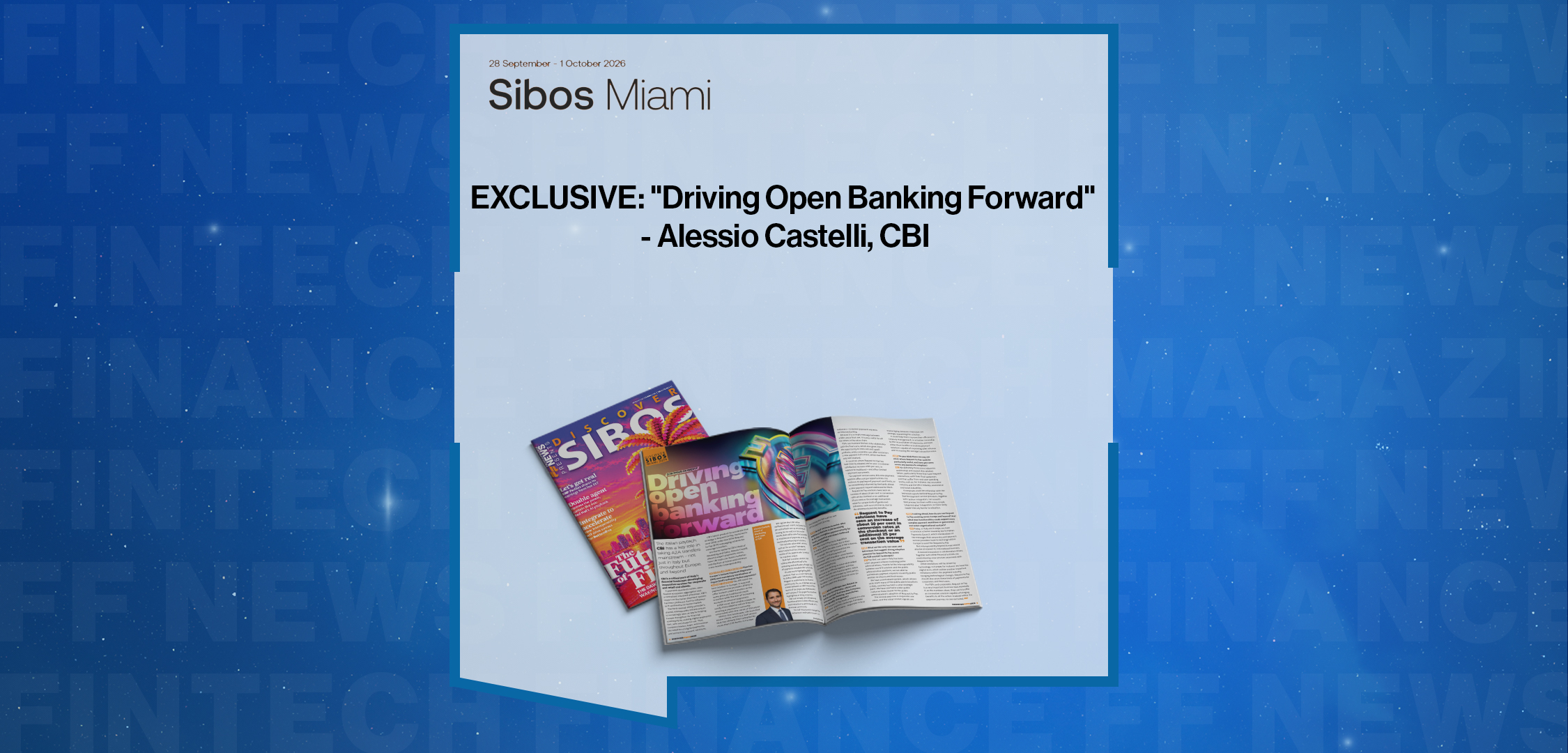
The Italian paytech CBI has a key role in taking A2A transfers mainstream – not just in Italy but throughout Europe, and beyond
CBI is a critical part of Italy’s financial landscape developing innovative services for corporate and retail end clients. A payment standards setter, open finance ecosystem aggregator and a centralised interbank processor, CBI’s impact on the Italian payment system has been profound. And its influence isn’t confined to its home market. The bank-owned utility provider’s shared, interoperable infrastructure is increasingly seen as key to helping Europe strengthen its financial sovereignty by making digital payments fast, safe and cheap to use. That, European leaders hope, will increase the adoption of digital payments and account-to-account solutions.
CBI’s latest product to accelerate that strategy is Request to Pay, launched in June 2026 under the SEPA Request to Pay (RTP) messaging scheme for message transfers. Ian Horne spoke to CBI’s Head of Marketing and Sales, Alessio Castelli, about Europe’s payments vision, how CBI tools can boost customer satisfaction at home and enhance cross-border interoperability.
DISCOVER SIBOS MAGAZINE How has Europe’s Instant Payment Regulation (IPR) and mandatory Verification of Payee (VoP) reshaped Italian payments?
ALESSIO CASTELLI The IPR went live last October in Europe. It required payment service providers (PSPs) to offer instant credit transfers at the same price as traditional credit transfers with the aim of increasing account-to-account payments. A PSP must also enable a payer to verify if the IBAN to which they are sending a payment is correctly associated with the name of the payee. Within this landscape, CBI launched Name Check, which is a VoP service that has already been adopted by more than 250 banks in Europe.
We register about 200 million verifications each month, and almost 70 per cent of VoPs turn up a match result. Among the no-match or close-match results, there will be some fraud attempts or misdirection of payments, so we are continually enhancing our solutions. This includes value-added services, such as the so-called Trade Name, which collects all the commercial names of the payee in order to reduce ‘no matches’ output.
Bulk VoP is another solution that relieves the effort related to the unboxing and verification of single lines of payments included within a bulk file. It’s also worth highlighting IBAN Lookout. That is a service that is able to detect IBAN codes that have been flagged as suspicious by the financial community. So, you may have a correct match between an IBAN code and the name of the payee, but IBAN Lookout will tell you if this payee has also been highlighted as being suspicious.
CBI had already centralised many functionalities to allow efficiency and cost reduction to all the banks in its financial community. The VoP requirement changed the behaviours and habits of users, so that today the VoP is at the core of the payment journey.
DSM As VoP continues to evolve, what additional features is CBI developing to further strengthen payment security for banks, corporates and citizens inside and outside of Europe?
AC The Instant Payments Regulation is widely adopted in Europe, but in other countries there are other kinds of VoP schemes. In Europe, the VoP functionalities are connected to instant payment and traditional credit transfers – cross-border interoperability is very useful for all actors involved in payments.
CBI is also working on other value-added services to be offered together with the Name Check for anti-fraud purposes, which could rely on data provided by third parties, to obtain a very detailed final risk score for both the payee and the payer.
DSM What challenges does Request to Pay solve for corporates, citizens and public services? And how does it improve processes like invoicing, reconciliation and liquidity management?
AC Request to Pay marks a milestone in the European payments landscape. It enables payment service users – corporates or final customers – to receive payment requests via internet banking. Because it is a simple message between a biller and a final user, it is very useful for all the actors in the value chain.
PSPs can maintain the last-mile relationship with the final users, which also gives them the opportunity to cross-sell and upsell products, while corporates can offer customers a new payment instrument, which has been very well received. In countries where Request to Pay has been heavily adopted, we’ve seen a customer satisfaction increase of 85 per cent, in relation to traditional – and often limited – payment instruments.
For payment service users, this new payment solution offers unique opportunities. For instance, to pay beyond payment card limits, or be immediately informed by the banks about a new payment request addressed to them. Request to Pay solutions have seen an increase of about 20 per cent in conversion rates at the checkout or an additional 25 per cent on the average transaction value for certain kinds of goods and industries, such as e-commerce, due to the aforementioned key benefits.
DSM What are the early use cases and behaviours that suggest strong adoption potential for Request to Pay across the B2B and B2G landscapes?
AC The first use case in Italy has been a B2G payment scheme involving public administrations. Thanks to the interoperability between our RTP solution and the public administration platform, we are able to orchestrate payment requests issued by public entities to citizens and businesses. We have a centralised system, which allows us to reach many of the public administrations in Italy, and this has been a vital strategic point. We have reached a wider public customer base, thanks to the public administration’s adoption of Request to Pay. The second step now is corporate use cases, and the initial market signals are encouraging, because corporates are strongly requesting this solution.
It could help them improve their efficiency in treasury management, in activities connected to the reconciliation of payments, and even allow them to offer innovative payment solutions capable of improving sales volumes and increasing the average transaction value.
DSM Do you think there are any use cases where Request to Pay could be particularly useful, and have you come across any barriers to adoption?
AC We definitely think some industries could adopt and exploit this solution better, particularly those that have frequent interactions with their final customers and that suffer from end-user spending limits, such as, for instance, the insurance industry and the telco industry, ecommerce and travel industries.
A corporate could be unfamiliar with the technical aspects behind Request to Pay. But the payment service providers, together with system integrators, can smooth that process for them with a very simple ‘plug-and-play’ integration, so there really needn’t be any barrier to adoption.
DSM Looking ahead, how do you see Request to Pay evolving across Europe and beyond? And what new functionalities could support more complex payment workflows in government and wider organisational contexts?
AC Today, in Italy and Europe, we have a common scheme issued by the European Payments Council, which standardises all the messages that corporates and payment service providers have to exchange within Europe to send the Request to Pay.
But interoperability beyond Europe would also be of interest to international business. A second innovation is collaboration-driven. Together with other financial entities, we could develop new services associated with Request to Pay. Other evolutions will be driven by technology. In Europe, for instance, we have the digital euro, which will be another important milestone within the payment industry, bringing technological changes. Request to Pay should also serve these kinds of payments for corporates and final users.
For PSPs and corporates, Request to Pay is a very important business tool, especially if, as the numbers show, they use it to offer an innovative solution capable of bringing benefits to all the actors involved within the payment journey, no one excluded.