A Thread Through Time: What Mastercard's Payeux Tapestry Tells Us About the Future of Buying
By Ali Paterson · 9 September 2026
A Thread Through Time: What Mastercard's Payeux Tapestry Tells Us About the Future of Buying
By Matthew Burls, Producer, FF News
There is a particular kind of pleasure in walking into the Royal Exchange on a Monday lunchtime and finding a tapestry waiting for you.
Not a screen. Not a hologram. Not a demo running on a laptop balanced on a lectern. An actual woven tapestry, made of thread, hanging in a building that has been the beating heart of London commerce since the sixteenth century.
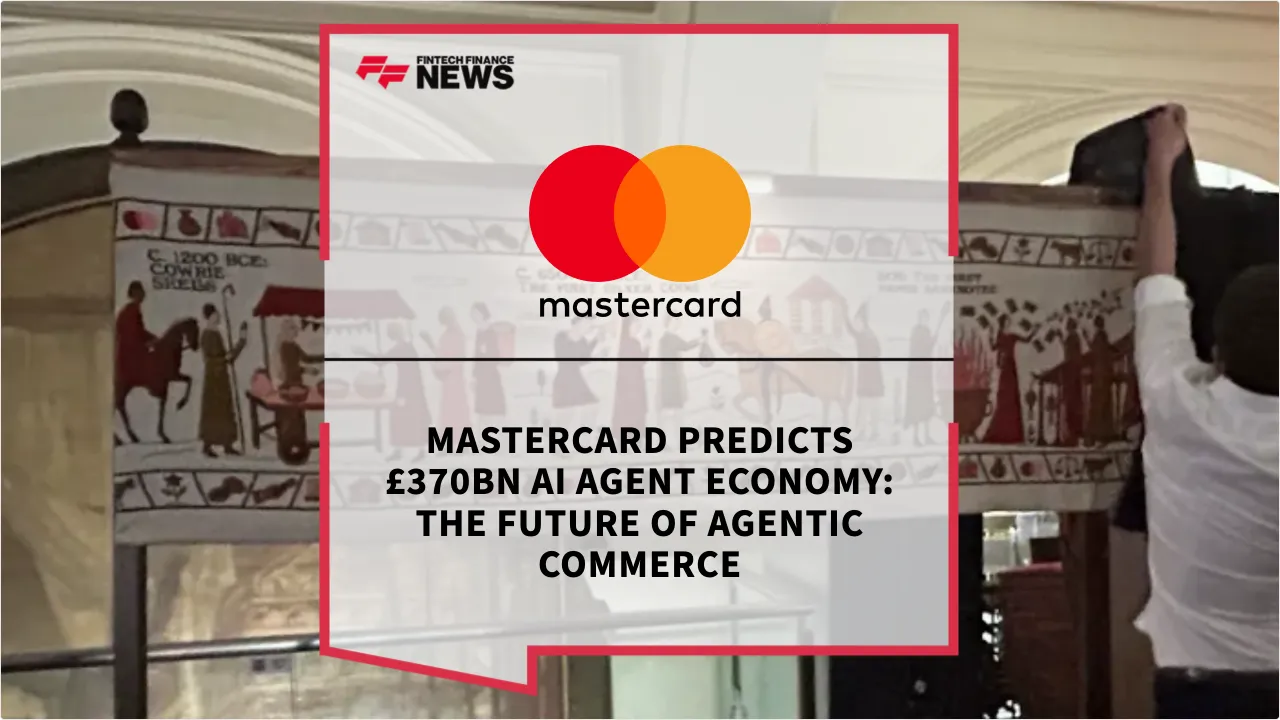
Mastercard called it the Payeux Tapestry, and yes, the pun landed exactly as intended. The original Bayeux Tapestry recorded a moment when everything changed, stitched by hand so that people a thousand years later would still know what happened. This one, created by the artist Mia Hansson, does something similar for commerce. It traces the long strange journey of how we pay each other, and it does so using one of the very few workshops left in this country still operating heritage machines.
I want to dwell on that choice for a moment, because I think it is the smartest thing about the whole event.

Mastercard could have launched its new futures report with a slick film and a stage full of LED panels. Instead it commissioned a physical object made by traditional methods, and then used it to talk about artificial intelligence agents buying your groceries. The contrast is the argument. Commerce has always been changing, always been evolving, and every single time it has done so, it has looked impossibly strange to the people living through it.
Seashells, coins, notes, cheques, agents
The occasion was the launch of a new Mastercard report called A Short History of the Future of Shopping and Payments, and the case it makes is a substantial one. More than one in ten online shoppers are expected to routinely use AI agents to purchase on their behalf by 2030. That is more than 300 million people globally, and a forecast £370 billion a year of AI driven consumer demand.
Agnes Woolrich, SVP of Mastercard UK, opened by framing the stakes plainly. Agentic commerce has the potential to transform not only how markets are held together but how businesses sell in the first place. Most people in the room, she noted, had already experimented with using agents for search, for shopping, for recommendations. The next step is the one that matters, and the next step is payment.
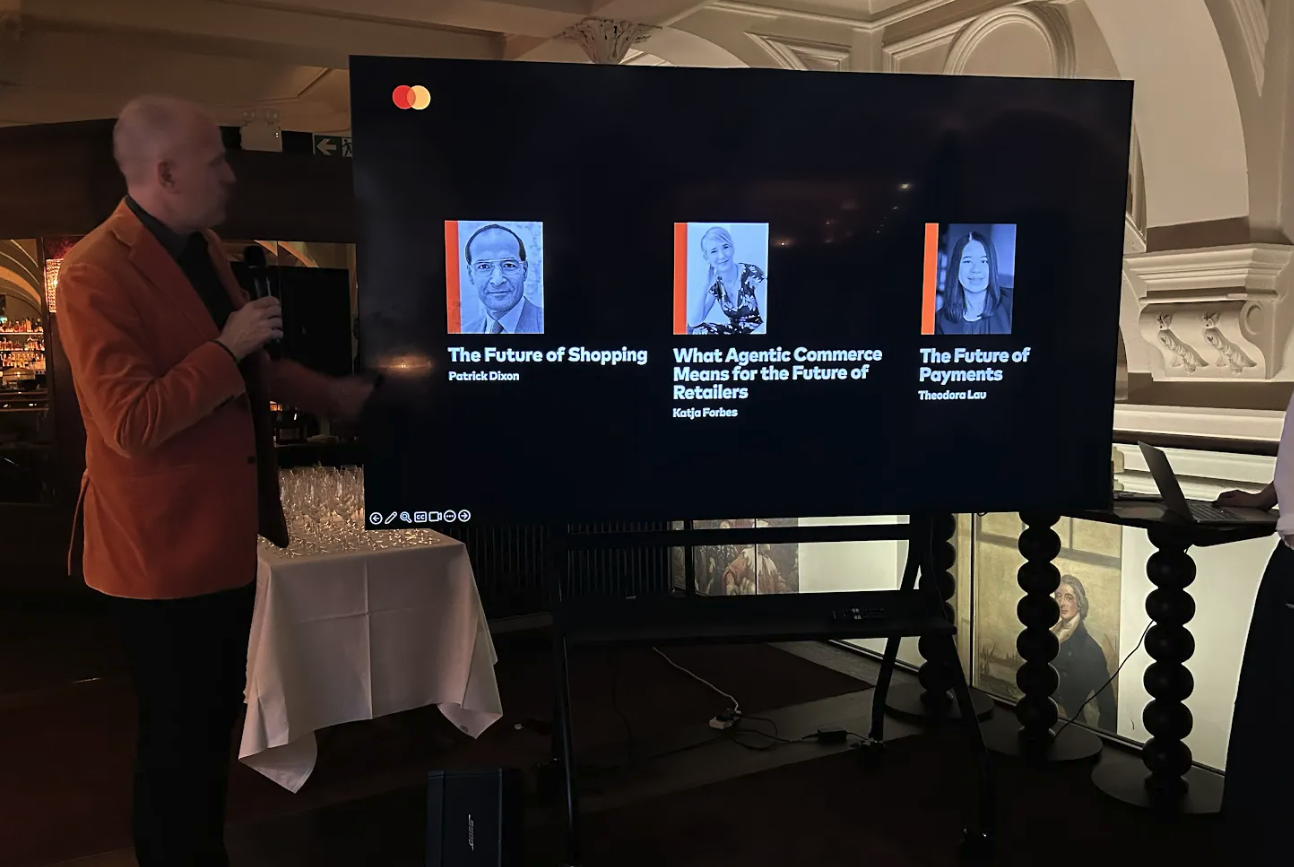
To get there, Mastercard engaged four internationally recognised futurists: Theodora Lau on payments, banking and finance, Katja Forbes on retail, Patrick Dixon MBE on consumers and shopping, and Magnus Lindkvist as lead.
It was Lindkvist who took the room.
The cone of possibility
Lindkvist is a Swedish futurologist, trendspotter and author, and he opened by cheerfully announcing that he had lost his phone that morning and was therefore enjoying a rare phone free day. It set the tone for a keynote that was funny, generous and considerably sharper than the genre usually allows.
His framing device was what he calls the cone of possibility. In the very short term, he explained, we have the wonderful help of blogs, newsflashes and spreadsheets to understand the present. But as you move further out along the cone, you have to be open minded about things that are strange, stupid, wrong and magical. That is the discipline of the work, and it is a useful corrective to the confident certainty that usually accompanies any conversation about AI.
From there he offered three predictions.
The first is the power of no. Lindkvist argued that one of the genuine killer applications of agentic commerce will not be the agent that buys things for you, but the agent that stops you. No, do not do that. No, why are you doing that? No, Sicily in the summer is awful, go in October instead. So much of what we do in commerce runs on guesswork and impulse. An agent, if you let it, becomes a hand on the shoulder, gently pointing you somewhere better.
The second is the difference between shopping and buying. This was the observation that has stayed with me longest. Lindkvist pointed out that we do not say "hospitaling" for healthcare or "cinema-ing" for watching films, and yet shopping has become a word that covers two completely different human activities. There is shopping, which for a visiting Swede means the glorious business of coming to the best city in the world and enjoying it. And then there is buying: the procuring, the chores, the automatically renewing subscriptions, the getting lost in marketing messages and losing track of what things should cost.
By 2030, he suggested, those two words will no longer mean the same thing. Agents will take the buying. What they hand back is the time and the space to enjoy the shopping, whether that is online or on Oxford Street.
The third came from Theodora Lau's chapter, and it is the phrase that will define the next five years of compliance conversations: know your agent. If you work in banking or payments, you know your customer and you know your client. Those obligations exist to establish that there is a flesh and blood person somewhere in the world, and they are not going anywhere. But increasingly the counterparty will be a piece of software. Call it a bot, call it a robot, call it a pet, as Lindkvist put it. The question becomes how you know that client, how you understand what it is, and how it demonstrates verifiable intentions.
Lau's own forecast is that at least three G20 regulators will issue formal guidance on registering and monitoring AI agents by 2030. Payment intent, in other words, becomes as valuable as the payment itself.
Trust as infrastructure
Lindkvist closed on the thing underneath all of it.
Trust, he said, is the lifeblood and the invisible glue. It is what makes nations thrive and holds everything together beneath the surface. And historically it has been a feeling, which is to say it has been accidental. You cannot command it. If someone says "trust me", well, maybe not.
What changes now is that trust becomes part of the infrastructure. It moves from a feeling to a fact, from a hunch to a verifiable intent expressed in a machine.
This is the strategic heart of the report, and it is where Mastercard's own positioning sits most comfortably. Simon Forbes, President of Mastercard UK and Ireland, noted that for sixty years the company has been helping people pay and get paid simply and securely, and that this purpose continues through what may be one of the most significant shifts in retail shopping in decades. The infrastructure work is already visible: Mastercard Agent Pay for securing agent led transactions, Agent Suite for helping retailers and their partners build and deploy agents, and the Proto Agentic Sandbox, launched last month and announced here in the UK, where businesses can test whether their products are even discoverable by an agent before anything goes near production.
The next customer cannot read your brochure
For anyone selling anything, there is one practical takeaway buried in the report that deserves more attention than it will get.
Retailers are about to acquire a new kind of customer. Not a person browsing, but an agent that can read reams of data, verify claims, and scan thousands of reviews in seconds before deciding. That customer does not respond to a beautifully art directed campaign. It responds to whether your product information, your claims and your policies are machine readable.
The report's own example is a good one. A sustainability claim is no longer a line of copy. It needs to come with a certificate that an agent can find, read and verify. Loyalty programmes, customer relationships and digital experiences will all need rebuilding on that basis.
That is not a 2030 problem. That is a next financial year problem.
The generation already there
If any of this feels distant, Mastercard's accompanying research should settle it. Working with Opinium across thirteen markets, the company surveyed 13,000 parent and teenager pairs, 26,000 respondents in total, with 2,000 in the UK.
More than a third of teenagers, 36 per cent, say they would happily use a fully AI run shopping assistant that recommends, chooses and pays on their behalf, compared with 24 per cent of their parents. Teens are twice as likely as their parents to be using AI weekly to hunt down the best price or discount, at 18 per cent against 10 per cent.
The trust numbers are the ones that should make people sit up. A third of teenagers, 33 per cent, say they would trust an AI's product recommendation over a friend's. More than a quarter, 27 per cent, would trust it over their own parents' advice. And 62 per cent of young people in the UK already believe AI will significantly change how their generation shops.
Meanwhile 63 per cent of parents expect AI shopping to define their child's generation. Only 6 per cent think it will define their own.
They are almost certainly wrong about that.
Back to the thread
Late in the session, Lindkvist offered a short history of money that I have been turning over ever since. We started out swapping seashells. Those became coins, then notes, then cheques. Constantly evolving, always looking permanent right up until the moment it was not.
Which brings us back to the tapestry hanging in the Royal Exchange, made on old machines by an artist working in a tradition that predates every payment rail in the building.
The point of putting it there was not nostalgia. It was to remind a room full of payments people that every great shift in commerce has been, at bottom, a shift in trust: from the marketplace to the mall, from the catalogue to the click of a button. Each one asked people to place their trust somewhere new, and each one looked ridiculous shortly before it looked inevitable.
Agentic commerce is simply the next panel. The businesses that prepare for it now get to decide how they are depicted on it.
Matthew Burls attended the launch of A Short History of the Future of Shopping and Payments at the Royal Exchange, London.